
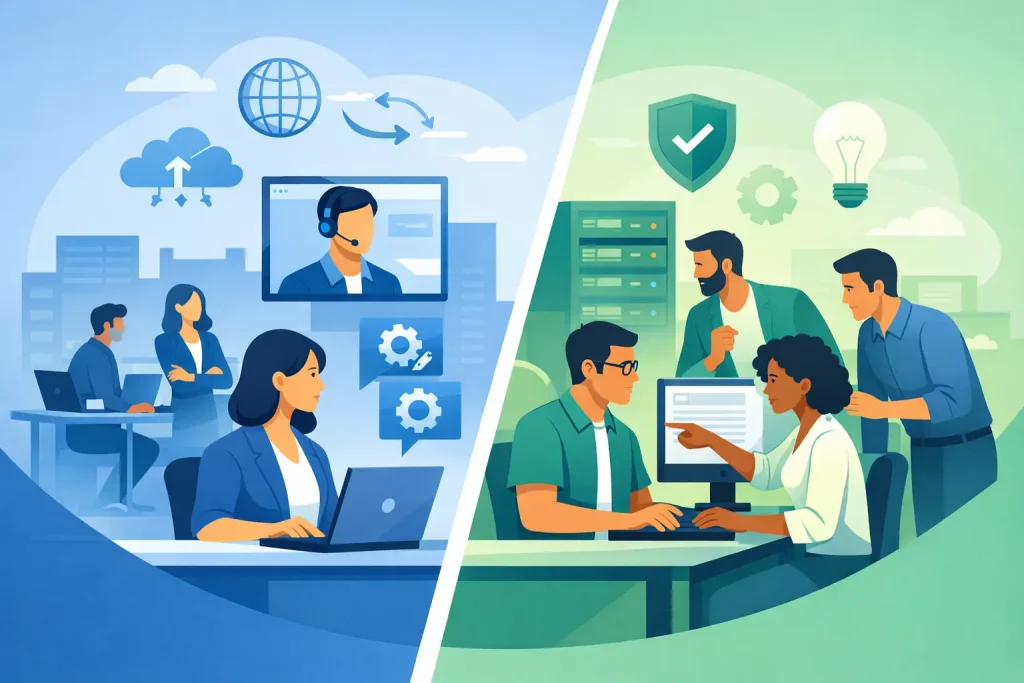
When a server fails at 8.30 on a Monday morning, the question is not whether your IT model looks good on paper. It is whether somebody can fix the issue quickly, protect data, and keep staff working. That is where the outsourced IT vs internal team decision becomes practical rather than theoretical for many small and mid-sized businesses.
For some organisations, an internal team provides close control and day-to-day visibility. For others, outsourced support delivers broader technical coverage, stronger resilience, and a more predictable cost base. The right answer depends on business size, risk exposure, internal capability, and how much technology complexity your operation carries.
Outsourced IT vs internal team: the core difference
An internal IT team is employed directly by the business. They work inside your organisation, understand your people and processes in detail, and are available as part of your internal structure. That can be valuable where IT is deeply tied to specialist systems, regulated workflows, or constant on-site operational support.
Outsourced IT means partnering with an external provider to deliver some or all of your technology support. That may include service desk cover, infrastructure management, cybersecurity, Microsoft 365 administration, backup oversight, cloud support, patching, hardware advice, and strategic planning. Instead of building every capability in-house, you access a wider technical function through a managed service arrangement.
The difference is not simply location. It is also about coverage, depth of expertise, accountability, and how risk is managed.
Cost is rarely as simple as salary vs contract
Many businesses begin with cost, but the true comparison goes beyond wages. An internal hire brings salary, National Insurance, pension contributions, training costs, recruitment fees, software licensing, management time, and the operational impact of absence or staff turnover. If one person covers your entire IT estate, there is also a single point of dependency.
Outsourced IT usually works on a monthly service fee or a blended support model. That can look more expensive at first glance, but it often includes access to multiple specialists, monitoring systems, security tooling, documentation standards, and continuity processes that would be difficult to reproduce with one or two internal hires.
For a smaller business, the economics often favour outsourcing because the need is broad rather than deep. You may need help with networking, cyber hygiene, user support, cloud platforms, procurement, backup testing, and compliance issues, but not enough volume in each area to justify separate internal roles.
Larger organisations can reach a point where an internal function becomes more cost-effective for high-volume, highly specific support. Even then, many still outsource parts of the stack, especially security monitoring, project delivery, or out-of-hours cover.
Control matters, but so does capacity
One of the strongest arguments for an internal team is control. Internal staff are embedded in the business. They attend meetings, understand informal processes, and can respond to issues in the context of operational priorities. That proximity can improve communication and make IT feel more aligned to the business.
However, control without capacity can become fragile. A single internal IT manager may know your systems well, but no one person can be an expert in infrastructure, cyber security, cloud architecture, end-user support, compliance, procurement, and disaster recovery at the same time. If that person is on leave, overloaded, or leaves the business, the apparent control disappears quickly.
An outsourced partner introduces more structure. Requests are logged, systems are documented, and responsibilities are defined within service levels. You may give up some immediacy of having someone physically present every day, but in return you gain access to a wider operational bench and a support model that does not stop when one individual is unavailable.
Security is where the gap often becomes clear
For most businesses, security is now one of the most important factors in the outsourced IT vs internal team discussion. Threats have become more persistent, and the required controls are more demanding than basic antivirus and a firewall.
A capable internal team can deliver excellent security, but that depends on experience, budget, and leadership support. Smaller internal teams often spend most of their time on immediate support issues. Strategic security work such as patch governance, identity control, backup validation, vulnerability remediation, and incident response planning can slip down the list.
A managed IT provider is more likely to bring established processes around monitoring, patching, access management, endpoint protection, backup oversight, and policy enforcement because these services sit at the centre of its operating model. That does not mean outsourcing automatically makes you secure. It means a good provider can usually apply a more disciplined framework than a stretched internal generalist.
The key point is accountability. Whether IT sits inside or outside the business, somebody must own risk, maintain standards, and ensure security tasks are carried out consistently.
Internal knowledge vs external breadth
Internal teams generally hold stronger business-specific knowledge. They know which systems are business-critical, which departments have recurring issues, and where operational workarounds exist. That insight is difficult to replicate quickly.
Outsourced providers bring breadth. They see multiple environments, recurring failure points across different sectors, and the practical consequences of poor configuration, weak backups, or unmanaged change. That wider exposure often leads to better preventative work. They are less likely to accept legacy problems as normal because they can compare your environment against current standards and proven support methods.
This is one reason many businesses benefit from a hybrid model. An internal lead keeps close alignment with business priorities, while an outsourced partner provides specialist depth, tools, and operational support.
Which model scales better?
If your business is growing, scaling IT support matters. New starters need devices, permissions, software access, and policy controls. Offices move. Cloud estates expand. Cyber requirements tighten. The support model that worked at 20 users may not hold at 80.
An internal team can scale well if growth is planned and recruitment keeps pace. The challenge is timing. Businesses often add internal IT resource after strain is already visible. Service delays, inconsistent setups, and undocumented systems appear before the next hire is approved.
Outsourced support tends to scale more smoothly because the provider already has service capacity, standard onboarding processes, and access to specialist roles. That is particularly useful for businesses in periods of change, including acquisitions, office expansion, cloud migration, or cyber remediation work.
That said, if your organisation runs highly specialised applications or complex operational technology, internal ownership may still be necessary. External support works best when the provider can build a detailed understanding of your systems and your business gives it enough visibility to do the job properly.
When an internal team is the better fit
An internal team is often the right choice where IT is central to the product, where systems require continuous on-site engineering support, or where the business has the scale to justify multiple specialist roles. It can also suit organisations that need very close daily collaboration between IT and operational departments.
It is a stronger option when you can fund not just one person, but a function with enough depth to avoid key-person risk. That means documented processes, holiday cover, training, and clear ownership across support, infrastructure, and security.
When outsourced IT is the better fit
Outsourced support is often the better fit for small and mid-sized businesses that need reliable IT management without building a full department. It works well when technology is essential to operations but not the core product of the company.
It is especially useful where there are recurring support issues, inconsistent security practices, ageing infrastructure, or no clear long-term plan for IT. In these situations, an experienced provider can introduce order, reduce disruption, and improve resilience faster than a business can recruit and build capability internally. For organisations that need dependable day-to-day support and broader technical stewardship, this is where a partner such as Cyan IT fits naturally.
The most practical answer is often a blended model
The outsourced IT vs internal team debate is often presented as either-or, but that is not how many businesses operate successfully. A hybrid model is common and often sensible.
You might keep an internal operations or systems lead who understands the business, manages suppliers, and handles local coordination, while outsourcing service desk support, cyber security controls, infrastructure maintenance, or project delivery. That gives you internal visibility without relying entirely on one person.
The quality of the model depends less on labels and more on clarity. Who owns security decisions? Who responds to incidents? Who maintains documentation? Who tracks backups, patching, asset lifecycle, and access control? Weakness usually appears where responsibility is vague.
Before deciding, assess your environment honestly. Look at support demand, system complexity, compliance needs, downtime tolerance, and your exposure if a key individual leaves. The strongest IT model is the one that keeps the business stable, secure, and supportable as it grows. If that means external expertise, internal ownership, or a combination of both, the priority is not preference. It is operational continuity.