
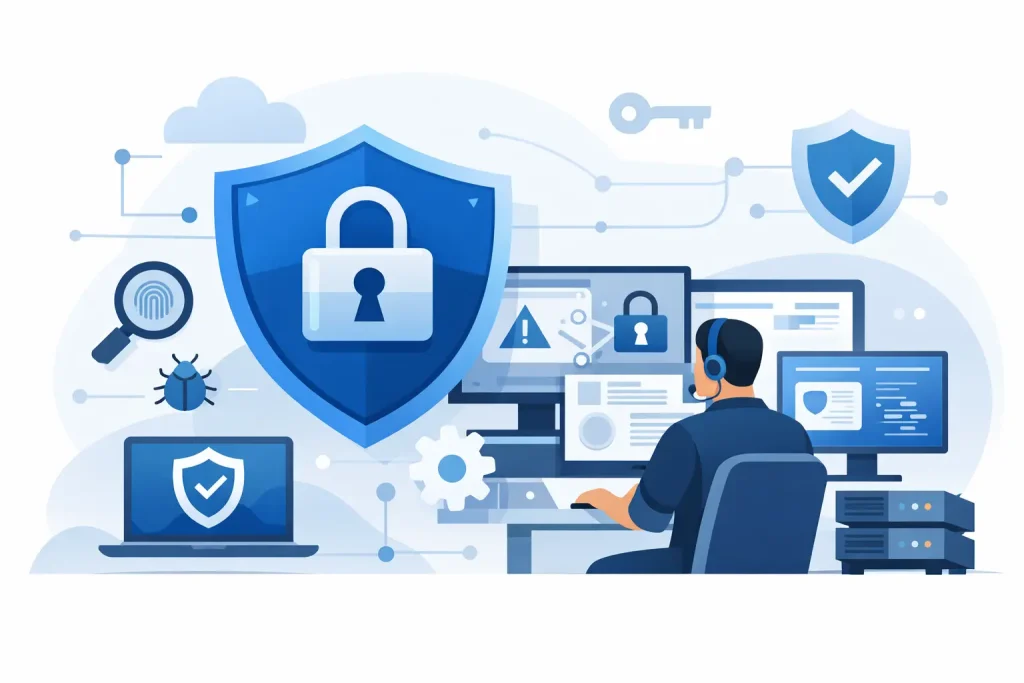
Most security problems in smaller organisations do not start with a dramatic breach. They start with a missed patch, an overlooked alert, a reused password, or a member of staff clicking on something they should not. That is where managed cyber security services become practical rather than theoretical. For many businesses, they provide the coverage, monitoring and expertise needed to reduce risk without carrying the cost of a fully staffed internal security function.
For decision-makers, the question is rarely whether cyber risk exists. It is whether the business has enough time, visibility and specialist capability to manage that risk properly. In smaller and mid-sized organisations, the answer is often no. Internal teams are busy keeping users productive, supporting systems, handling suppliers and dealing with day-to-day technical issues. Security then becomes reactive, which is exactly when weaknesses begin to build.
What managed cyber security services actually cover
Managed cyber security services are outsourced security functions delivered on an ongoing basis by a specialist provider. The scope varies, but the model is consistent. Rather than buying tools and expecting your internal team to watch everything, respond to alerts and maintain controls, you hand defined security responsibilities to a partner with the people, processes and technology to do that work continuously.
That can include endpoint protection, firewall management, vulnerability scanning, patch oversight, email security, identity protection, threat monitoring, incident response support and security reporting. In some cases, it also extends to user awareness training, compliance support and business continuity planning.
The important point is that this is not just software with a support number attached. A managed service should combine tooling with oversight, review and intervention. If nobody is interpreting alerts, investigating suspicious activity or checking whether controls are working as intended, the service is incomplete.
Why businesses use managed cyber security services
The main driver is not always fear of attack. More often, it is lack of internal capacity. Many organisations have one internal IT generalist, a small support team, or no dedicated technical staff at all. They may be capable of handling printers, laptops, user accounts and routine supplier issues, but cyber security demands a different level of attention.
Threats move quickly, while internal teams work to business hours and operational priorities. Attackers do not care whether your IT lead is on annual leave or focused on a server issue. They exploit delay, inconsistency and gaps in visibility. A managed approach helps close those gaps.
There is also a financial reality. Building an in-house cyber security capability means recruiting experienced staff, maintaining specialist tools, training the team and creating processes for monitoring and escalation. For many small and mid-sized businesses, that is disproportionate to budget and difficult to sustain. Managed services offer access to broader expertise at a more predictable monthly cost.
The difference between IT support and security management
This distinction matters. Good IT support keeps people working. Good security management reduces the chance that those same systems become a route for compromise.
There is overlap, of course. Patching, user permissions, device management and backup oversight all sit close to core IT operations. But cyber security requires a more deliberate focus on prevention, detection and response. It is not enough to set up antivirus and assume the job is done. Security controls need to be reviewed, alerts need to be investigated and configuration decisions need to be made with risk in mind.
That is why businesses often look for a provider that can integrate managed IT support with managed cyber security services. Done properly, that relationship is simpler to govern and faster to act. The service desk sees operational issues, the infrastructure team understands the estate, and the security function can apply controls in context rather than in isolation.
What a good managed security service should deliver
A useful service starts with visibility. You need to know what devices, users, applications and systems are in scope. If the provider cannot tell you what is being protected, reporting will mean very little.
From there, the focus should move to risk-based control. Not every business needs an enterprise-grade security stack, but every business does need sensible baseline protection. That usually includes managed endpoint security, email filtering, multi-factor authentication, secure backup practices, vulnerability management and firewall oversight.
Monitoring is where many services either justify their value or fall short. A constant stream of alerts is not a service outcome. What matters is whether those alerts are reviewed, prioritised and acted on in a timely way. Businesses should expect clear escalation paths, defined response responsibilities and regular reporting that explains what happened and what needs attention.
Support during an incident is equally important. No provider can promise that an incident will never happen. What they should be able to provide is a controlled, practised response. That means identifying what has occurred, isolating affected systems, limiting spread, preserving evidence where necessary and helping the business recover in an orderly way.
Where the trade-offs sit
Managed services are effective, but they are not magic. A business still has responsibilities. Senior decision-makers still need to set risk appetite, approve policy, enforce staff behaviour and invest in the basics. If weak passwords are tolerated, unsupported systems remain in use and critical updates are postponed for convenience, the service will be working against preventable problems.
There is also a question of scope. Some providers handle monitoring and advice, while the client retains responsibility for infrastructure changes. Others deliver a broader managed service that includes hands-on remediation. Neither model is automatically better. It depends on your internal capability, your regulatory pressures and how quickly you need action to be taken when issues appear.
Cost can be another point of uncertainty. A cheaper service may look attractive if it includes core tooling, but low-cost security arrangements often rely heavily on automation with minimal analyst input. That may be acceptable for low-risk environments, but businesses with sensitive data, operational dependence on IT, or customer-facing systems usually need more than basic alert forwarding.
How to assess whether your business needs it
If your team cannot confidently answer what devices are protected, how threats are monitored, who reviews alerts and how incidents are escalated, there is likely a gap. The same applies if cyber security is spread between several vendors with no clear ownership.
Warning signs tend to be operational rather than dramatic. Patches are applied inconsistently. User access is rarely reviewed. Backups exist, but no one is certain whether recovery has been tested. Staff receive phishing emails and there is no structured awareness programme. Reports from security tools are generated, but not interpreted.
These are all manageable issues, but only if someone has clear responsibility for managing them. That is often the value of a provider such as Cyan IT. The service gives a business a defined security operating model rather than a loose collection of products and assumptions.
Choosing the right managed cyber security services provider
The right provider should be able to explain its service in plain business terms. That includes what is covered, what is excluded, how incidents are handled, what response times apply and what reporting you will receive. If the proposal relies on jargon and product names without making responsibilities clear, caution is sensible.
It is also worth testing how the provider thinks about your business rather than security in the abstract. A manufacturer, a professional services firm and a multi-site office will have different operational risks. Security controls should support the way the organisation actually works, not force unnecessary complexity into it.
Look for maturity in process as much as technology. Clear onboarding, asset discovery, baseline assessments, documented escalation and regular service reviews are all signs that the provider treats security as an ongoing management discipline. That is usually more valuable than an impressive toolset on its own.
The best arrangements are collaborative. Your provider should not simply send monthly reports and disappear. They should help you make sensible decisions about priorities, exposure and practical improvement. Cyber security works best when it is treated as part of business continuity, not as a separate technical issue discussed only after something has gone wrong.
Managed cyber security services are not really about buying protection as a product. They are about putting qualified oversight around the systems your business depends on, so risk is controlled before disruption becomes expensive.