
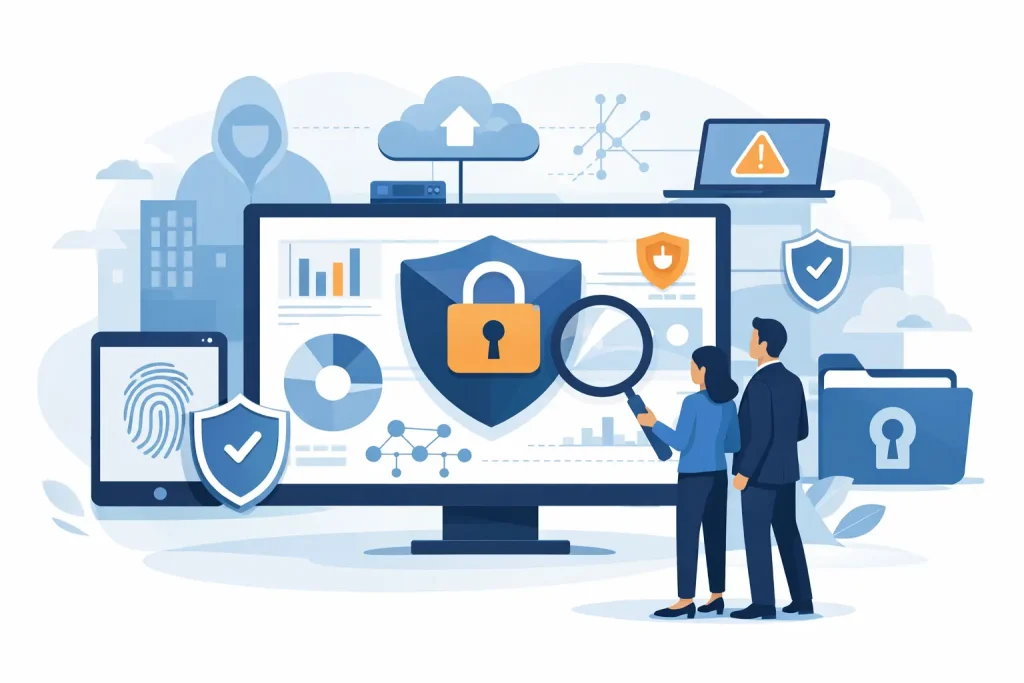
A missed software patch, a reused password or an old supplier account left active for too long can be enough to create a serious security issue. That is why cybersecurity oversight services matter to growing businesses. They provide ongoing scrutiny of systems, users, suppliers and policies, so security is managed as an operational discipline rather than treated as a one-off technical task.
For many small and mid-sized organisations, the problem is not a complete lack of security tools. It is lack of oversight. Firewalls may be in place. Anti-virus may be installed. Backups may be running. Yet no one is consistently checking whether controls are working as intended, whether risks are increasing, or whether the business is exposed through a gap between systems, people and process.
What cybersecurity oversight services actually cover
Cybersecurity oversight services sit above individual tools. They focus on visibility, governance and continuous review. The aim is to make sure the right protections are in place, that they remain appropriate as the business changes, and that someone is accountable for identifying issues before they become incidents.
In practice, this often includes monitoring the overall security posture of the business, reviewing access controls, checking patching and device compliance, assessing backup and recovery readiness, examining Microsoft 365 or cloud security settings, and maintaining awareness of emerging risks. It can also include policy guidance, user security standards, supplier risk review and support with incident response planning.
This is different from simply buying a security product. A tool may detect malicious activity, but oversight asks broader questions. Are alerts being reviewed? Are privileged accounts properly controlled? Are former employees fully removed from all systems? Is remote access still configured in a sensible way for the way your team now works?
Why oversight matters more than another security product
Many businesses accumulate security products over time without gaining real control. One supplier provides anti-virus, another handles backups, Microsoft settings are adjusted internally, and broadband or firewall changes sit with a connectivity provider. Each element may work in isolation, but the business still lacks a joined-up view.
That creates risk in two ways. First, important gaps can sit between service areas. Second, decision-makers may assume they are protected because several tools are in place, when no one is actively validating the whole picture. Oversight closes that gap by providing regular review, technical interpretation and clear accountability.
It also helps avoid a common mistake among smaller organisations – treating cybersecurity as an occasional project. Security posture changes constantly. Staff join and leave. Devices age. New cloud services appear. Permissions expand. Suppliers gain access. Oversight services recognise that risk moves with the business and needs active management.
Cybersecurity oversight services for firms without internal security teams
Most small and mid-sized organisations do not need a full internal security department, but they do need informed security leadership. That is where cybersecurity oversight services offer practical value. They give business leaders access to ongoing technical judgement without the cost and complexity of building specialist capability in-house.
This matters particularly for operations managers, office managers and directors who have security responsibility added to an already full role. They do not need jargon or abstract threat commentary. They need to know what is exposed, what needs attention, what is already controlled and what level of risk is acceptable for the organisation.
A good oversight service translates technical findings into business impact. If patching is inconsistent, the discussion should not stop at software versions. It should explain where exposure sits, which devices or users are affected, and what action is proportionate. If multi-factor authentication is incomplete, the conversation should focus on account compromise risk and operational priority, not just platform features.
What good oversight looks like in practice
Effective oversight is measured by consistency, not noise. It should create a regular rhythm of review and action. That may mean scheduled security reporting, monthly or quarterly posture reviews, remediation tracking and clear escalation when issues need urgent attention.
It should also be tailored to the organisation. A business handling sensitive client data, operating in a regulated sector or supporting remote staff across multiple locations will need a different level of oversight from a small office with limited systems and a straightforward risk profile. More oversight is not always better if it produces complexity without action.
Good service is also specific about responsibility. One of the main causes of avoidable exposure is uncertainty over who owns which part of security. Is user access managed internally or by the IT provider? Who checks backup integrity? Who signs off policy changes? Who reviews leavers and supplier access? Oversight works best when those lines are defined and reviewed.
The business benefits go beyond security
Although the primary goal is reducing cyber risk, oversight has wider operational value. It improves visibility across IT, supports better decisions on investment and helps prevent disruption caused by overlooked technical debt. In many cases, the same review process that identifies security weaknesses also reveals unsupported hardware, poor account management or fragile backup arrangements.
That is particularly useful for organisations that have grown quickly or changed working practices over time. Security issues rarely appear on their own. They are often symptoms of broader inconsistency in infrastructure, support processes or user management. Oversight brings those issues into view before they create downtime, compliance concerns or reputational damage.
There is also a commercial benefit in being able to demonstrate control. Customers, insurers and partners increasingly ask sensible questions about how systems are protected and reviewed. A business that can show regular oversight, documented actions and a defined approach to risk is in a much stronger position than one relying on informal assumptions.
Where businesses often get it wrong
One mistake is assuming compliance equals security. A completed questionnaire or policy document may help with procurement or insurance, but it does not guarantee that settings are correct or controls are maintained. Oversight tests the lived reality of security, not just the paperwork.
Another mistake is focusing only on external threats. Most practical weaknesses are more ordinary. Excessive permissions, old laptops still in use, inconsistent patching, mailbox security gaps, weak offboarding and poor visibility of third-party access all create exposure. These are not dramatic problems, but they are common and exploitable.
There is also a tendency to delay oversight until after an incident, particularly in businesses that have managed without obvious problems for years. That can be costly. Once data is lost, systems are encrypted or clients are affected, the conversation changes from prevention to damage limitation. Oversight is valuable precisely because it is preventative.
Choosing the right cybersecurity oversight services
The right service should fit the size, complexity and risk profile of the business. Some organisations need close ongoing governance with regular board-level reporting. Others need practical monthly review and clear recommendations tied to day-to-day IT support. The best approach depends on how much internal capability exists, how critical systems are and how quickly the environment changes.
Look for a provider that can assess the whole operational picture rather than pushing a single product set. Security oversight should account for users, devices, cloud platforms, backup, access control, policies and supplier relationships. If the service only reports on one tool, it is not giving meaningful oversight.
Clarity also matters. Reports should be understandable to non-specialists while still technically credible. Recommendations should be prioritised, proportionate and linked to business risk. A dependable partner will explain trade-offs. Some actions are urgent, some are advisable, and some depend on budget, sector requirements or growth plans.
For organisations that already use outsourced IT support, integrating oversight into the wider service model often makes sense. Security is rarely separate from infrastructure management, user support and continuity planning. A joined-up approach can reduce gaps, speed up remediation and make accountability easier to manage. For businesses working with Cyan IT, that alignment supports a more controlled and resilient operating environment.
Security oversight is ongoing stewardship
Cybersecurity is not strengthened by anxiety or by buying every available tool. It improves when someone is paying consistent attention, asking the right questions and following issues through to resolution. That is the real value of oversight.
For decision-makers, the practical test is simple. If you cannot clearly explain who reviews your security posture, how risks are tracked and whether controls are working as expected, then oversight is probably missing. Putting that structure in place does not just reduce exposure. It gives the business a steadier footing to operate, grow and respond when conditions change.
The most effective security arrangements are usually the least dramatic – well managed access, regular review, clear ownership and fewer unanswered questions.