
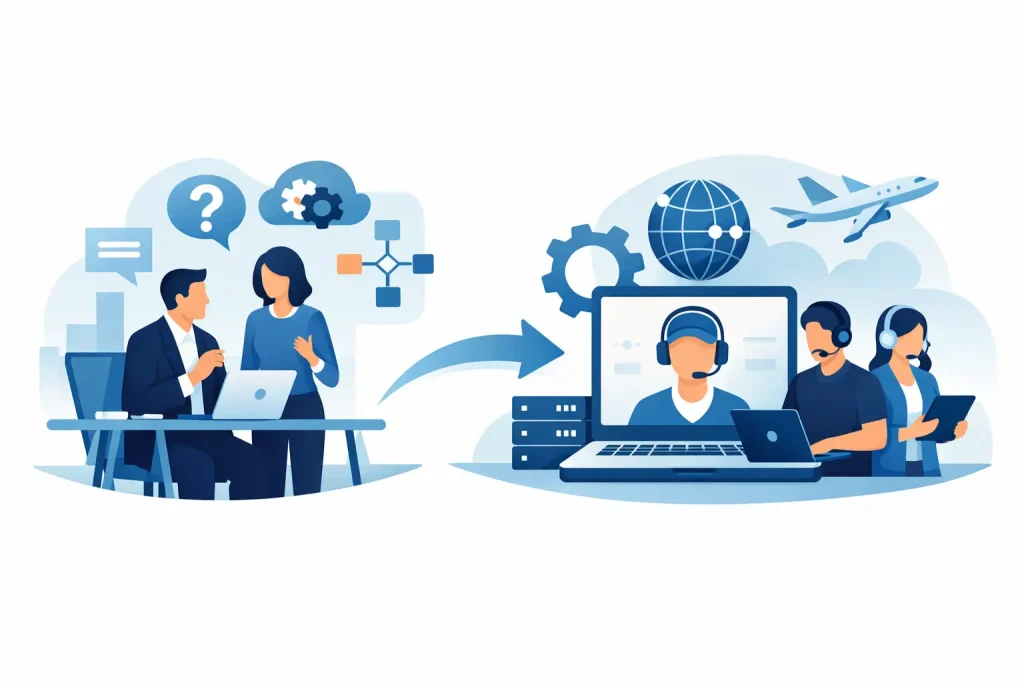
A server failure at 9am, a phishing email opened at 9:15, and no one in the business quite sure who owns the response by 9:30 – that is usually the point when the question becomes urgent. When should companies outsource IT? In most cases, the right time is not after a serious disruption. It is when the business can already see that technology risk, support demand, or infrastructure complexity is moving beyond what internal resources can manage reliably.
For small and mid-sized organisations, IT often grows in an uneven way. One person informally looks after user accounts, another speaks to software vendors, and an external contractor appears when something breaks. That can work for a while. It stops working when systems become business-critical, security expectations increase, and downtime begins to affect staff, customers, or compliance.
When should companies outsource IT as they grow?
Growth is one of the clearest triggers. A business with ten users can often manage with ad hoc support and basic cloud tools. A business with fifty users, multiple locations, remote access, line-of-business applications, and regulatory obligations needs something more structured.
At that stage, outsourcing is less about replacing an internal function and more about introducing consistency. Businesses need patching schedules, user onboarding and offboarding, device standards, backup monitoring, access control, and a clear escalation path when incidents occur. Without that structure, IT becomes reactive. Problems are fixed one by one, but the underlying environment remains exposed.
Growth also creates cost pressure. Hiring a full in-house team with broad capability across support, infrastructure, cyber security, Microsoft 365, networking, procurement, and continuity planning is expensive. For many organisations, outsourcing gives access to those skills without carrying the full employment cost of building that capability internally.
The clearest signs it is time to outsource
Most businesses do not reach a decision because of one dramatic event. More often, several smaller warning signs begin to appear at the same time.
If staff are regularly waiting too long for support, that is one sign. If recurring issues keep returning, that is another. If nobody can say with confidence whether backups are working, whether devices are fully patched, or who has administrative access to key systems, the business has already moved into a higher-risk position.
Another sign is dependence on a single individual. That might be an internal employee who has become the default IT contact, or a freelance technician who knows the estate but has limited capacity. This creates fragility. Annual leave, illness, resignation, or simply delayed response can become an operational problem.
Supplier sprawl is also common. One company handles telephony, another manages printers, someone else sold the firewall, and software renewals are spread across several vendors. Outsourcing IT to a managed partner can bring those moving parts under one accountable structure. That matters because fragmented responsibility often means delayed diagnosis and unclear ownership when something goes wrong.
Security is often the deciding factor
Many businesses can tolerate a degree of inconvenience. They cannot tolerate a security incident that stops operations or exposes sensitive data.
If your organisation is handling customer records, financial data, employee information, or commercially sensitive files, security can no longer sit in the background. Threats are not limited to large enterprises. Smaller firms are often targeted precisely because they have weaker controls, older devices, poor password discipline, or inconsistent monitoring.
This is one of the strongest answers to the question of when should companies outsource IT. It is appropriate when the business needs security controls that it cannot design, monitor, or maintain internally. That might include endpoint protection, multi-factor authentication, patch management, email security, backup testing, access reviews, and incident response procedures.
Outsourcing does not remove accountability. Leadership still owns business risk. What it does provide is a more controlled environment, supported by specialists who are managing protection as an ongoing discipline rather than as a side task.
When internal IT is stretched too thin
Outsourcing is not only for businesses with no IT staff. It is also relevant for organisations with a capable internal team that is overloaded.
In-house staff are often pulled towards immediate user issues, office moves, hardware rollouts, and project demands. Strategic work then slips. Documentation is incomplete, system reviews get postponed, and preventative maintenance becomes irregular. Over time, that creates technical debt and operational exposure.
An external provider can take responsibility for day-to-day support, infrastructure monitoring, or specialist areas such as cyber security and cloud management. That allows internal staff to focus on systems knowledge, business change, and priorities that are specific to the organisation.
This hybrid model often makes sense where the business wants internal ownership but needs broader coverage, better resilience, and access to specialist expertise that would be difficult to recruit directly.
Cost matters, but not in the simplistic way
Some businesses start considering outsourced IT because they want to reduce cost. That can be valid, but it should not be the only lens.
The cheaper option on paper is not always the better one in practice. Low-cost support that does not provide proper monitoring, security controls, or response discipline may simply defer more expensive problems. Equally, employing in-house may appear attractive until pension contributions, training, toolsets, cover arrangements, recruitment time, and skills gaps are fully considered.
The more useful comparison is between predictable managed service cost and the total cost of unstable IT. That includes downtime, interrupted sales activity, delayed onboarding, security incidents, poor user productivity, and management time spent chasing suppliers. For many small and mid-sized organisations, outsourcing improves cost control because it replaces unpredictable firefighting with a clearer support model.
When outsourcing may not be the right move
There are situations where full outsourcing is not the best answer. A business with a mature internal IT department, specialist systems, and strong governance may only need targeted external support. In that case, co-managed services or project-based assistance can be more appropriate.
There is also a transition issue to consider. If systems are undocumented, licences are unclear, or infrastructure has been neglected for years, the first phase of outsourcing may involve remedial work. That is still often worthwhile, but decision-makers should understand that a provider cannot create order instantly without visibility, process, and investment.
The right question is not whether outsourcing is always better than in-house. It is whether your current model gives the business enough resilience, security, accountability, and capacity for what it now depends on.
What a business should expect from outsourced IT
A credible outsourced IT arrangement should provide more than a helpdesk number. It should establish ownership, standards, and oversight.
That means defined service levels, documented processes, device and user management, monitoring, backup visibility, cyber security controls, and regular reporting. It should also improve decision-making. Businesses need to know what is in place, what needs attention, and where future risk or investment sits.
Good outsourced support should feel steady rather than dramatic. Fewer recurring issues, quicker resolution, clearer accountability, and better system hygiene are usually better indicators of value than occasional heroics during an outage.
For businesses that need dependable external expertise, a provider such as Cyan IT is not there simply to fix faults. The role is to support continuity, reduce preventable risk, and keep technology aligned with day-to-day operations.
How to decide if now is the right time
If technology problems are distracting leadership, if security expectations have increased, if staff support is inconsistent, or if the business would struggle to cope with the loss of one key IT contact, the timing is probably right to review outsourcing.
The best decisions are usually made before a crisis forces them. Waiting until after a ransomware event, a major outage, or a failed audit leaves far less room for planning.
A practical approach is to assess where the current model is weakest. That may be support coverage, cyber security, supplier management, documentation, cloud administration, or continuity planning. Once those gaps are visible, it becomes easier to judge whether internal resources can realistically close them.
For many growing organisations, the answer is not that in-house IT has failed. It is that the business has reached a stage where informal support is no longer enough. The sensible time to outsource is when continuity, security, and operational control start to matter more than making do.