
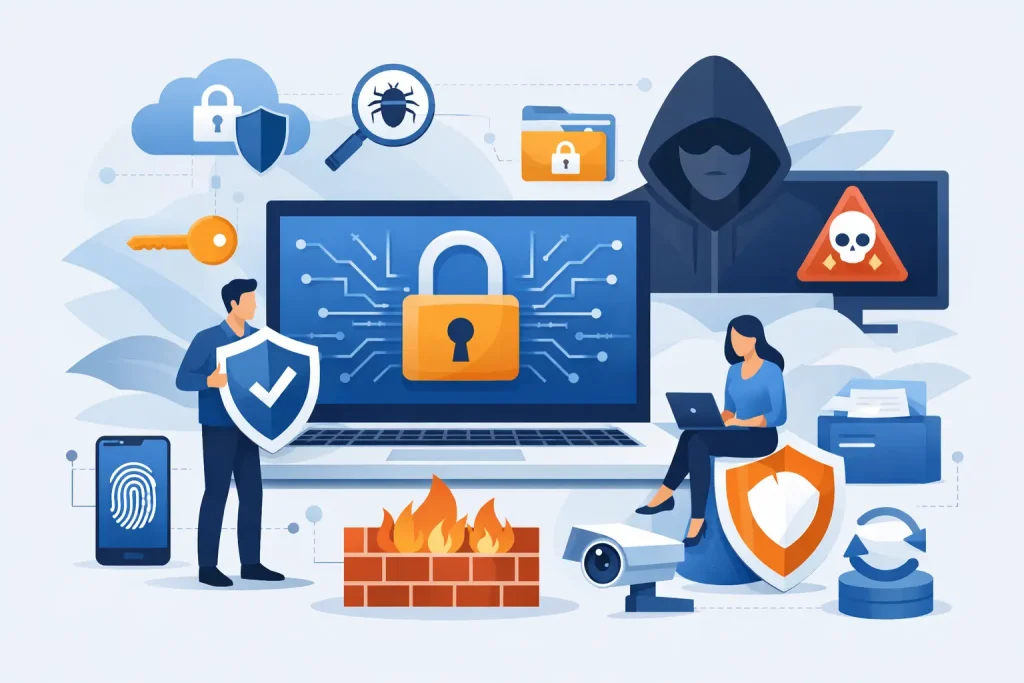
Ransomware rarely starts with a dramatic technical failure. More often, it begins with an ordinary email, a reused password, or a missed software update that seemed harmless at the time. For small and mid-sized organisations, the best ways to prevent ransomware are usually not exotic security tools, but disciplined controls applied consistently across users, devices, data and access.
The challenge is that ransomware operators no longer rely on a single route in. They combine phishing, credential theft, vulnerable remote access, unpatched systems and lateral movement inside the network. That means prevention has to be layered. One control helps, but a sensible set of controls working together is what materially reduces risk.
Why ransomware prevention needs a business approach
Ransomware is not just an IT issue. It is an operational risk that can stop finance systems, lock shared files, interrupt customer service and affect compliance obligations. Even where recovery is possible, the cost of downtime, investigation and disruption can be far greater than the ransom demand itself.
That is why the strongest prevention strategies are tied to business continuity. The aim is not simply to block malware. It is to reduce the chance of compromise, limit how far an attacker can move, and make recovery realistic if something does get through.
Best ways to prevent ransomware in practice
Keep backups isolated and tested
Backups remain one of the most important protections because they change the outcome of an attack. If data can be restored cleanly and quickly, the pressure to pay is reduced. However, many businesses still make the mistake of treating any backup as a safe backup.
For ransomware defence, backups need separation from the main environment. If attackers can reach backup repositories using stolen admin credentials, they will often encrypt or delete them first. A sensible approach includes immutable or offline backup copies, restricted access to backup systems and routine testing of restores. Testing matters because an unverified backup is an assumption, not a recovery plan.
Patch operating systems, applications and firmware promptly
Many ransomware incidents exploit known vulnerabilities that already have fixes available. Delayed patching creates an avoidable exposure, particularly on internet-facing systems, VPN appliances, firewalls, servers and remote desktop services.
Patching should be risk-based rather than ad hoc. Critical security updates need a clear process, ownership and timescale. That may involve staged testing for core business applications, because patching too aggressively without validation can also create operational problems. The balance is straightforward: not every system can be updated instantly, but high-risk exposures should never sit unaddressed for weeks.
Reduce reliance on passwords alone
Compromised credentials are a common route into business systems. If remote access, cloud services or administrator accounts depend only on usernames and passwords, attackers have a simpler job. Multi-factor authentication adds an extra barrier and should be standard for email, remote access, privileged accounts and any externally accessible business platform.
This is especially important for Microsoft 365, remote desktop gateways, VPNs and backup consoles. Password policies still matter, but they are no longer sufficient on their own. Strong passwords help, yet they do not compensate for phishing, credential stuffing or password reuse across services.
Limit administrative privileges
One of the fastest ways ransomware spreads is through excessive permissions. If users have local admin rights they do not need, or if the same privileged accounts are used broadly across the environment, a single compromise can escalate quickly.
Privilege should be tightly controlled and assigned only where necessary. Standard users should operate without admin rights for day-to-day work. Administrative accounts should be separate from normal user accounts, used only for specific tasks and protected with stronger controls. This does add a little friction for support and system changes, but it significantly reduces the blast radius of an attack.
Secure email and train staff to spot risk
Most businesses know phishing is a problem, but awareness alone does not stop it. Staff need practical guidance on how suspicious emails actually appear in the course of normal work – invoice requests, document sharing prompts, password expiry notices, supplier messages and impersonated senior staff requests.
Email filtering, attachment scanning and domain protections all help, but user judgement is still part of the control set. Training should be short, regular and realistic rather than treated as an annual compliance exercise. The goal is not to turn every employee into a security analyst. It is to make unsafe actions less likely and early reporting more common.
Control remote access carefully
Remote access remains a major target. Exposed RDP services, weak VPN settings and unmanaged third-party access are still involved in many incidents. If remote access is necessary, it should be restricted, monitored and protected with multi-factor authentication.
Where possible, direct exposure to the public internet should be avoided. Access should be limited by role, time and source where practical. This is also an area where older configurations often linger because they were set up quickly and never reviewed. Those forgotten access paths can become the weakest point in the environment.
Segment systems so one breach does not become many
Flat networks make life easier for attackers. Once inside, they can move from one device or server to another with minimal resistance. Network segmentation is one of the best ways to prevent ransomware from becoming a full estate incident.
This does not require enterprise-scale complexity to be useful. Separating core servers from general user devices, restricting access between departments, and isolating backup infrastructure can all make a meaningful difference. Good segmentation also supports clearer monitoring because unusual traffic stands out more readily when access routes are defined.
Harden endpoints and servers
Endpoints are still where many attacks begin, and servers are often where the real damage is done. Security configuration should reduce unnecessary attack surface. That includes disabling unused services, restricting script execution where appropriate, controlling macros, applying application allowlisting in higher-risk environments and using centrally managed endpoint protection.
There is no single baseline that suits every organisation. A finance-heavy office, a warehouse operation and a professional services firm will have different software needs and user patterns. The principle is the same in each case: systems should run what the business requires, and little more.
Monitor for unusual behaviour
Prevention is stronger when it includes early detection. Ransomware attacks often show warning signs before encryption starts in earnest – unusual logins, privilege changes, mass file access, unexpected remote tools or suspicious activity outside normal working patterns.
For smaller organisations, this is often where gaps appear. Logs may exist, but nobody is reviewing them in a structured way. Managed monitoring, alerting and endpoint detection can help close that gap. The trade-off is cost and response capacity, but the alternative is often discovering an incident only after files are already inaccessible.
Build a clear security standard for suppliers and users
Third-party software, support partners and external contractors can all introduce risk if access is loosely governed. Supplier access should be documented, limited and reviewed. Shared accounts should be avoided, and dormant accounts should be removed promptly.
Internally, policies should be simple enough to follow. If staff are expected to work around security controls to remain productive, the controls need review. Prevention works best when secure behaviour is the easiest behaviour.
Prepare for the day prevention is tested
Even strong controls do not guarantee immunity. A realistic ransomware strategy includes an incident response process that people can actually use under pressure. Key contacts, system priorities, isolation steps, decision-making authority and recovery sequencing should not be left to improvisation.
This is where external support can make a measurable difference. Businesses without a large in-house IT function often benefit from a managed partner that can maintain patching discipline, monitor threats, review access, test backups and respond quickly when something looks wrong. For organisations that need dependable oversight without building a full internal team, that operational consistency matters as much as the technology itself.
The best ways to prevent ransomware are rarely flashy. They are the steady controls that remove easy opportunities, contain damage and keep recovery within reach. Security improves when those controls are treated as part of normal operations, not as a project that gets attention only after an incident. That is usually where resilience starts.