
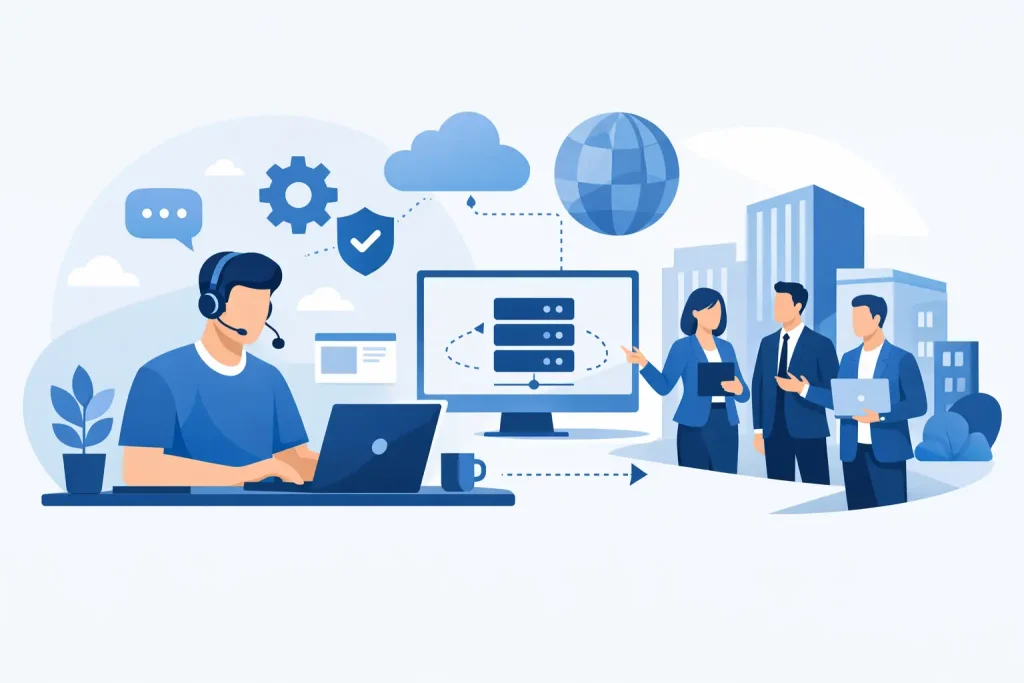
A server alert at 8:15 on a Monday rarely arrives on its own. It is usually followed by login issues, a printer queue that has stopped moving, and someone asking whether the backup completed overnight. For many growing firms, that is the moment the limits of ad hoc IT become obvious. Outsourced IT support for businesses is not simply a way to fix faults when they appear. It is a practical model for keeping systems stable, secure and properly managed without carrying the cost of a full internal team.
The appeal is straightforward. Most small and mid-sized organisations depend on business-critical technology every day, yet many do not need, or cannot justify, several in-house specialists across support, infrastructure, security and cloud administration. External IT support fills that gap. Done well, it gives a business access to broader technical capability, clearer accountability and a more consistent support structure.
What outsourced IT support for businesses actually covers
The term can mean different things depending on the provider and the contract. At the basic end, it may involve a helpdesk, remote troubleshooting and occasional on-site support. At the more strategic end, it can include proactive monitoring, patch management, Microsoft 365 administration, cyber security controls, backup oversight, vendor management, device lifecycle planning and guidance on infrastructure changes.
That distinction matters. Some businesses assume outsourcing means handing over passwords and calling a support number when something breaks. In practice, the value is much greater when the provider is responsible for prevention as well as response. Monitoring servers, checking backup status, reviewing failed updates and identifying capacity issues early often prevents the service interruption that users would otherwise experience first-hand.
For decision-makers, the real question is not whether support is internal or external. It is whether the arrangement gives the business dependable coverage, appropriate technical depth and a clear path for resolving problems.
Why businesses move away from informal IT support
A common pattern is that IT responsibility sits with whoever is most comfortable with technology. That might be an operations manager, office administrator or financially minded director who has gradually inherited software renewals, laptop purchasing and user access requests. It works for a while, usually until growth, compliance demands or recurring faults make it unmanageable.
At that point, outsourcing becomes less about convenience and more about risk control. Systems need structured oversight. Staff need timely support. Security settings need to be applied consistently. New starters and leavers need proper access management. If those tasks are handled inconsistently, the effect is cumulative. Downtime increases, vulnerabilities go unnoticed and nobody has a clear record of what is in place.
An outsourced partner can bring order to that environment. Documentation is formalised, support processes become repeatable and ownership becomes clearer. That is often the first major improvement clients notice – not a dramatic technology change, but a reduction in uncertainty.
The business case goes beyond cost
Cost is one reason firms consider outsourcing, but it should not be the only one. Comparing a monthly support agreement against the salary of one in-house technician is too simplistic. An internal hire may be excellent at desktop support but have limited experience in cyber security, cloud architecture or disaster recovery. Outsourcing often provides access to a wider team with different specialisms, which is difficult to replicate internally at the same price point.
There is also the issue of resilience. If one internal IT person is on leave, in meetings or leaves the company altogether, support coverage can drop immediately. A managed external service is generally less dependent on one individual. That reduces operational exposure.
That said, outsourced support is not automatically cheaper in every scenario. A larger organisation with complex internal systems, regulatory demands or a substantial user base may still need in-house IT leadership, or at least a hybrid model. The right choice depends on scale, complexity and how closely technology supports daily operations.
Where outsourced support delivers the most value
The strongest results usually appear in businesses where IT is essential but not their core discipline. Professional services firms, manufacturers, logistics companies, charities, healthcare providers and multi-site offices often need reliable systems without wanting to build a large internal technology function.
In those environments, external support can reduce downtime by improving maintenance discipline. It can strengthen cyber security through better patching, endpoint protection and user access control. It can also ease the burden on management by dealing directly with broadband providers, software vendors and hardware issues rather than leaving internal staff to coordinate each problem separately.
There is a strategic benefit too. A good provider should not only resolve tickets but also identify weak points in the estate. That may include unsupported devices, fragmented file storage, poor backup retention or ageing firewall hardware. These are not always urgent on any given day, but they become expensive if ignored.
What to expect from a competent provider
Businesses should expect more than technical language and a list of tools. A reliable outsourced IT partner should be able to explain what is being managed, how incidents are prioritised, what security controls are in place and where the current risks sit.
Response times are important, but so is service structure. If every problem relies on the same person noticing an email, the support model is fragile. There should be a defined process for triage, escalation and reporting. Routine tasks such as software updates, monitoring checks and user onboarding should be handled consistently rather than improvised.
Clarity also matters in commercial terms. Businesses need to know what is included in support, what falls under project work and where additional costs may arise. Ambiguity in service scope often leads to frustration later.
For that reason, the strongest providers tend to combine service desk capability with infrastructure management and security oversight. They are not simply reacting to user issues. They are maintaining the environment as an operational asset.
Common concerns about outsourcing IT
The most frequent concern is loss of control. Some businesses worry that an external provider will become a gatekeeper, holding knowledge about systems that the company itself does not fully retain. That is a valid concern if documentation is poor or access arrangements are unclear.
The answer is not to avoid outsourcing. It is to insist on proper governance. Asset records, admin access, licence visibility, backup reporting and network documentation should all be maintained transparently. A dependable provider should support that level of visibility, not resist it.
Another concern is responsiveness. Decision-makers often fear that an external helpdesk will treat their issues as one of many. Service levels matter here, but so does relationship quality. A provider that understands the business, its key systems and its working patterns will generally support it more effectively than one working from a generic script.
This is where a service-led partner stands apart from a break-fix supplier. The goal is not just to close tickets. It is to protect continuity.
How to judge whether your business is ready
If IT issues are repeatedly distracting senior staff, if cyber security feels uncertain, or if there is no clear record of systems and responsibilities, the business is likely ready for a more structured support model. The same is true if growth has outpaced internal processes and new locations, users or cloud tools are being added without central control.
A sensible first step is to review the current environment honestly. Are backups checked or simply assumed to be working? Are devices patched consistently? Who manages leavers’ access? How quickly are faults resolved, and by whom? If the answer to most of those questions is vague, the risk is already present.
For many organisations, outsourced support works best when it starts with stabilisation. That means documenting assets, reviewing security controls, identifying obvious weaknesses and putting routine support on a managed footing. Once that foundation is in place, planning becomes much easier.
A provider such as Cyan IT would typically be most valuable in that role – not as an occasional fixer, but as a consistent external function responsible for keeping technology dependable, protected and aligned with business needs.
Choosing the right model
Not every support contract should look the same. Some businesses need a fully managed arrangement covering users, devices, cloud services and security. Others need a co-managed model where an internal employee handles day-to-day liaison while the external provider delivers specialist support and infrastructure oversight.
The right model depends on the maturity of the business and the criticality of its systems. What matters most is that responsibility is clear. If an issue arises with backups, Microsoft 365 permissions or a firewall rule, there should be no confusion about who owns it.
Outsourced IT support is most effective when it reduces uncertainty. That means fewer avoidable faults, faster resolution when issues do happen, and a clearer understanding of the risks that need attention next. For businesses that rely on technology but do not want to build a large internal IT department, that kind of stability is not a luxury. It is part of running the business properly.
The useful question is not whether support can be outsourced. It is whether your current approach gives the business enough control, protection and continuity for the way it operates now.