
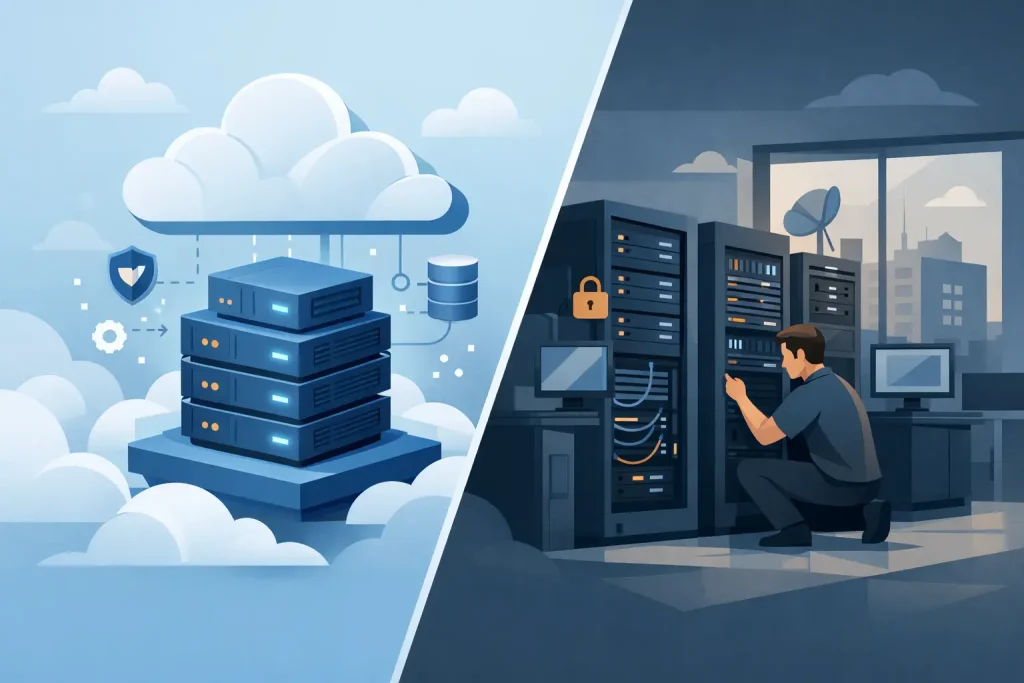
A server decision usually becomes urgent at the worst possible moment – when hardware is ageing, performance is dropping, support tickets are increasing, or a move to new software exposes the limits of your current setup. That is why the question of cloud servers versus on premises matters less as a technical debate and more as a business risk decision. For most small and mid-sized organisations, the right answer depends on how much control you need, how much disruption you can tolerate, and how prepared you are to maintain the environment properly over time.
Cloud servers versus on premises: what is the difference?
Cloud servers run in a provider-managed data centre and are accessed over the internet or private connectivity. You are usually paying for capacity, storage, backup and related services as an operating cost. The physical infrastructure, power, cooling and much of the resilience sit outside your building.
On premises infrastructure sits within your own office, site or private facility. Your business owns or leases the hardware directly and takes responsibility for maintenance, replacement planning, power protection, local backup arrangements and physical security. In return, you have more direct control over the system and how it is configured.
At a basic level, cloud shifts more responsibility to an external platform, while on premises keeps more responsibility in-house. That sounds simple, but the implications spread into budgeting, support, compliance, continuity and growth.
Cost is rarely as straightforward as it looks
Many businesses first compare purchase price against monthly fees and assume the cheaper line wins. In practice, cost needs to be looked at over several years.
On premises can appear better value if you already have server hardware, licences and internal knowledge in place. Once purchased, the equipment may serve reliably for years. For stable workloads with predictable usage, that can make financial sense.
The difficulty is that the visible purchase cost is only part of the picture. You also need to account for warranty cover, replacement cycles, battery backups, storage growth, air conditioning, energy use, backup systems, disaster recovery arrangements and the time needed to administer everything properly. When hardware fails, there is no abstraction layer protecting you from the event. The risk sits with your business.
Cloud services reduce the need for large upfront capital spend, which can be useful for growing organisations or those trying to preserve cash flow. They also make it easier to scale up or down. But cloud is not automatically cheaper. If systems are oversized, left unmanaged or allowed to grow without governance, monthly costs can rise steadily and become difficult to predict.
A sensible cost comparison should look beyond year one. It should include support effort, downtime exposure, replacement planning and recovery capability, not just the price of a server or the cost of a subscription.
Security depends on management, not just location
One of the most common misconceptions is that one model is inherently secure and the other is not. The reality is more disciplined than that.
Cloud platforms can offer very strong security controls, including monitored data centres, advanced resilience, access policies, audit logging and backup options that many smaller businesses would struggle to replicate internally. That is a significant advantage if your organisation lacks dedicated IT resource.
However, cloud security still depends on how the environment is configured. Weak permissions, poor identity management, absent monitoring and inconsistent patching can create serious exposure even on a well-built platform. Moving to the cloud does not remove the need for active oversight.
On premises systems offer direct physical control and may suit organisations with specific regulatory or operational requirements. Some businesses are more comfortable knowing exactly where systems are hosted and who can physically access them. That can be valid, especially where legacy applications, specialist devices or strict internal controls are involved.
But on premises security standards are only as good as the time, expertise and investment behind them. If patching is delayed, backups are not tested, firewall rules are outdated, or equipment is left beyond supported life, local infrastructure can become more vulnerable than expected.
For most organisations, the better question is not which model sounds safer in theory. It is whether your business can consistently maintain a secure standard in the model you choose.
Performance and reliability are tied to your real working pattern
Performance discussions often become too general. What matters is how your staff actually use systems.
If your team works mainly from one location, relies on a local line-of-business application and needs very low-latency access to large files or specialist devices, on premises may still be the better fit. Local infrastructure can deliver excellent speed for office-based work when it is well designed and properly maintained.
If your staff work across multiple sites, from home, or while travelling, cloud services often provide a more practical operating model. Access is simpler to standardise, and resilience can be stronger than a single office server cupboard with one internet line and limited failover.
Reliability also needs to be considered honestly. An on premises server can perform very well for years, but it remains exposed to local events such as power failure, hardware faults, theft, fire or flood. Cloud environments are not immune to outages, but they are typically built with far more redundancy than a smaller business could justify on its own.
That does not mean every workload belongs in the cloud. It means reliability should be measured against actual risks, not assumptions.
Cloud servers versus on premises for growth and change
Businesses rarely stand still. New staff join, software changes, storage expands, and security requirements become stricter. Infrastructure needs to support those changes without creating friction.
Cloud platforms are often stronger where flexibility matters. Adding resources, provisioning new services or supporting remote users can usually be done faster than sourcing, installing and configuring new physical equipment. For organisations growing quickly or adapting to changing working patterns, this can remove a great deal of operational delay.
On premises can still support growth, but scaling usually requires planning further ahead. Hardware has fixed limits. If demand increases unexpectedly, expansion may involve procurement delays, installation work and additional capital spend.
There is also the question of ageing systems. Many businesses keep on premises servers beyond their ideal lifecycle because replacement is disruptive or gets deferred. That can work until a software upgrade, cyber incident or hardware failure forces action under pressure. Cloud does not remove every lifecycle issue, but it can reduce the dependence on one ageing physical platform.
Compliance, backups and recovery often decide the issue
For decision-makers, resilience is often more important than the hosting model itself. If a server fails on Monday morning, how quickly can your business recover? If files are encrypted by ransomware, how recent is the clean backup? If a site becomes inaccessible, can staff continue working elsewhere?
These questions are where infrastructure decisions become practical.
A well-managed cloud setup can improve backup options, off-site recovery and business continuity. Data can often be replicated across locations, and services can be restored more quickly than with a single local server and a basic backup routine.
On premises can also meet strong recovery standards, but only if the supporting systems are in place. That may include off-site backup, tested disaster recovery procedures, hardware redundancy and regular review. Many smaller organisations believe they have adequate recovery until they test it properly.
Compliance adds another layer. Certain sectors may have obligations around data handling, retention, access control and auditability. Both cloud and on premises can be configured to support compliance, but not every setup will do so by default. The hosting decision should follow your operational and regulatory requirements, not just convenience.
In many cases, the best answer is hybrid
The discussion around cloud servers versus on premises is often framed as a straight choice. In reality, many businesses benefit from a hybrid model.
Critical legacy applications, specialist equipment or local file workloads may remain on premises, while email, backup, collaboration tools and selected business systems move to the cloud. This allows organisations to modernise gradually, reduce risk and avoid forcing unsuitable systems into a model that does not fit.
A hybrid estate does require careful management. If poorly planned, it can create complexity rather than solve it. But when designed properly, it can balance control, resilience and cost in a way that reflects how the business actually operates.
For organisations without a large internal IT function, this is often where an experienced managed partner adds the most value. The job is not to push every service into the cloud or keep everything local by default. It is to assess the commercial risk, technical dependencies and support burden, then shape an environment that is stable and supportable.
There is no serious infrastructure strategy built on fashion. Some businesses need the control of on premises systems. Others gain clear advantages from cloud. Many need a mix of both. The useful question is not which option sounds more modern, but which one gives your organisation the best balance of security, continuity, performance and operational clarity over the next few years.